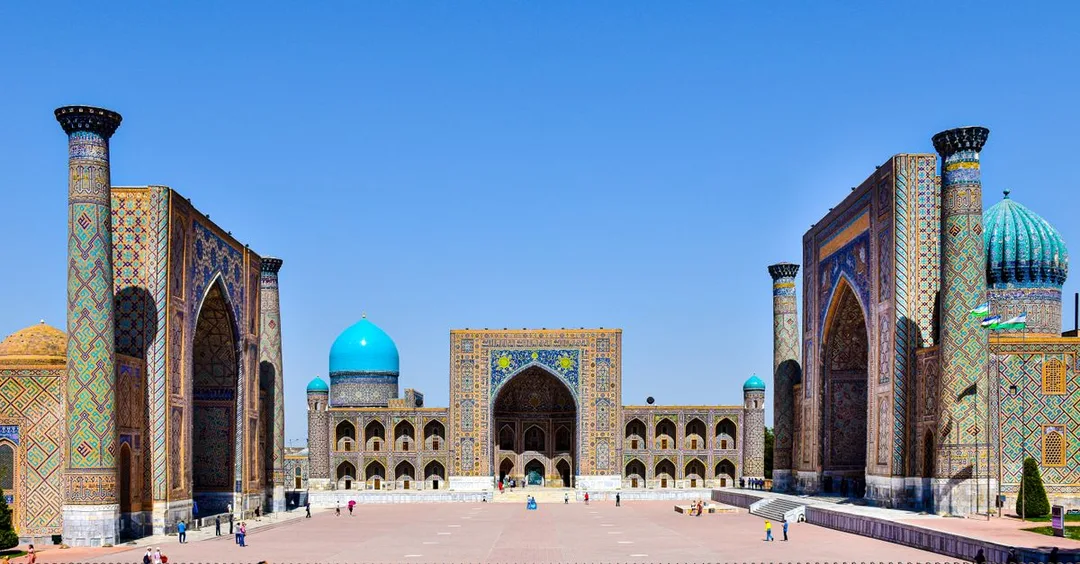
You step off the plane in Tashkent and the first thing that hits you is the light. It's that particular Central Asian gold, sharp and dry, bouncing off white marble like something out of a Mughal miniature painting. By the time you reach Samarkand and see the Registan for the first time, those three towering facades covered in turquoise tile work, you'll genuinely forget what you were worried about before you left home. This is one of those places that just works on you. Quietly, completely.
Uzbekistan has been on Indian travellers' radar for a few years now, and for good reason. The Silk Road cities feel familiar in the best way: the architecture echoes what the Mughals brought back to India, the food is close enough to feel comforting and different enough to be interesting, and the people are genuinely warm toward Indian visitors. Best of all, it's close, affordable, and wildly underrated.
This itinerary covers 7 nights and 8 days across Samarkand and Bukhara, designed specifically around how Indian travellers like to travel: good hotels, proper meals, enough history without exhaustion, and enough breathing room to actually feel somewhere new.
Your Trip at a Glance
- Day 1: Fly from Delhi or Mumbai, arrive Tashkent, transfer to Samarkand by train
- Day 2: Registan Square, Shah-i-Zinda, Bibi-Khanym Mosque
- Day 3: Gur-e-Amir Mausoleum, Ulugbek Observatory, local bazaars and evening at leisure
- Day 4: Day trip to Shakhrisabz (Timur's birthplace), return to Samarkand
- Day 5: Morning train to Bukhara, afternoon orientation walk around the old city
- Day 6: Ark Citadel, Kalon Minaret, Lyabi Hauz square, craft workshops
- Day 7: Bolo Hauz Mosque, Chor Minor, morning market visit, fly back to Tashkent
- Day 8: Tashkent layover or direct flight home
Day-by-Day Breakdown
Day 1: Arrival and the Train to Samarkand
Most flights from Delhi or Mumbai connect through Istanbul, Dubai, or Almaty into Tashkent. Flight time from Delhi is roughly 4 to 5 hours with a connection, sometimes less. Uzbekistan Airways also operates direct flights from Delhi to Tashkent, which is the most convenient option if timing works out.
Once you land at Tashkent International Airport, a private transfer takes you to the railway station. From there, the Afrosiyob high-speed train to Samarkand takes just over 2 hours and runs smoothly through flat, sun-baked steppe. The train is clean, punctual, and genuinely pleasant. You arrive in Samarkand early evening. Check into your hotel, freshen up, and walk to the nearest chaikhana (teahouse) for your first bowl of plov, the Uzbek national dish of rice slow-cooked with lamb, carrots, and whole garlic. It's rich, aromatic, and completely unlike any pilaf you've had before.
Sleep well. Tomorrow is a big day.
Day 2: The Registan and the Blue Domes
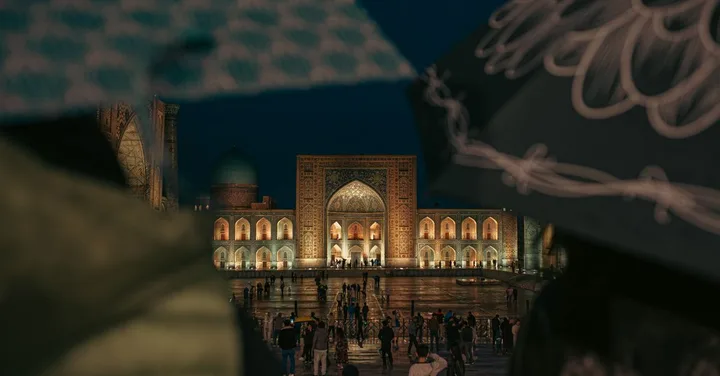
The Registan is one of those places you've probably seen in photographs a hundred times, and it still stops you cold in person. Three madrassahs arranged around a central square, each covered in intricate mosaic tile work in shades of cobalt, turquoise, and gold. The scale is massive. The silence inside the courtyards is almost meditative.
Go early. By 9 AM you'll have the square mostly to yourself, the light is perfect for photographs, and the heat hasn't built up yet. After the Registan, walk 15 minutes to Shah-i-Zinda, a lane of royal mausoleums from the 14th and 15th centuries. This one tends to hit harder than expected. The tiles here are more intricate, more personal somehow, and the atmosphere is part pilgrimage site, part open-air museum. Women in headscarves light candles alongside tourists with cameras and it doesn't feel incongruous at all.
End the day at Bibi-Khanym Mosque, built by Timur for his favourite wife. It's partially in ruins, which makes it feel more real than any restored monument. Have dinner at a restaurant near the Registan, order lamb shashlik and a cold Sarbast beer, and watch the square go golden in the evening light.
Day 3: Ulugbek's Observatory and the Old Bazaar
This day slows down a little, intentionally. Start at the Gur-e-Amir Mausoleum, where Timur himself is buried. The interior is covered in onyx and jasper and lit by filtered light that falls through the dome in a single shaft. There's something genuinely moving about standing next to the tomb of a man whose descendants built the Taj Mahal.
After that, head uphill to Ulugbek's Observatory. Ulugbek was Timur's grandson and one of the greatest astronomers of the medieval world. In the 15th century, from this spot, he calculated the length of a solar year to within 58 seconds of what modern instruments measure. The museum is small but excellent. It puts into perspective just how much knowledge was flowing through these cities when Europe was still in the dark ages.
The afternoon is yours. Walk through Siab Bazaar, which is the local market next to Bibi-Khanym, and pick up dried apricots, walnuts, and saffron. Uzbek saffron is excellent quality and cheaper than what you'd find in Indian spice shops, so stock up. This is also a good evening to Plan Your Trip, Contact Safari Sutra if you want any personalisation before the Bukhara leg.
Day 4: Shakhrisabz, the City Timur Called Home
About 90 kilometres south of Samarkand, across a mountain pass, is Shakhrisabz. This is where Timur was born, and he planned to be buried here too (his generals brought him back to Samarkand when he died far from home). The ruins of Ak-Saray Palace, his summer palace, give you a sense of what he was going for: the gateway alone was once 40 metres high. What's left is still enormous.
The drive over the Takhta Karach Pass is one of the more pleasant surprises of this itinerary. Green hills, grazing cattle, old Soviet trucks hauling melons. It's a proper road trip moment. Pack snacks or grab fresh bread from a roadside stall on the way. Shakhrisabz itself is quieter and less touristy than Samarkand, and the Kok Gumbaz Mosque there, with its pale blue dome, is one of the most beautiful in the country.
Return to Samarkand by early evening, pack your bags, and have a relaxed last dinner. The Caravan restaurant near the old city does excellent Uzbek dumplings called manti that you should not skip.
Day 5: Train to Bukhara
The Afrosiyob train from Samarkand to Bukhara takes about 1.5 hours. You arrive mid-morning, which gives you a full afternoon to get your bearings in the old city. Bukhara is different from Samarkand in a way that's hard to explain until you're there. Samarkand feels grand and imperial. Bukhara feels alive, like a city that never quite stopped being a trading post on the Silk Road.
Check into your hotel, ideally one inside or right next to the old city walls. The boutique riads and caravanserais-converted-to-hotels here are genuinely lovely and give you an atmospheric base. After settling in, do a slow orientation walk from Lyabi Hauz, the central pond square, through the covered bazaars toward the Kalon Minaret. The minaret is 47 metres tall, built in 1127, and it's so impressive that Genghis Khan, who destroyed almost every other building in Bukhara, ordered it to be kept standing.
Dinner at Lyabi Hauz square is the thing to do. Every restaurant there serves the same few dishes but the setting, the pool reflecting the old madrassa walls, justifies sitting longer than you'd planned.
Day 6: The Deep Bukhara Day
This is your full day in Bukhara and it's the one most Indian travellers say stays with them longest. Start at the Ark Citadel, a fort that's been the seat of Bukharan power for 15 centuries. The views from the top across the old city are worth every step up.
Then visit the covered bazaars, each one historically dedicated to a specific trade: silk merchants, money changers, spice traders. You can still buy hand-woven ikat fabric here, and the quality is extraordinary. A good suzani (a traditional embroidered textile) makes a far better souvenir than anything you'd find at a duty-free. After lunch, look for a small craft workshop where you can watch artisans doing wood carving or miniature painting. Many welcome visitors without any sales pressure.
End the day back at Lyabi Hauz for sunset. Order green tea, a plate of halva, and just watch the pigeons wheel around the Nadir Divan-Begi Madrassa. It's a genuinely peaceful hour.
Day 7: Last Morning, Then Tashkent
Use your final morning for the places that don't make every itinerary. Bolo Hauz Mosque, a short walk from the Ark, has a stunning carved wooden iwan with 20 tall wooden pillars that reflect in the small pond in front of it. Chor Minor, a quirky little building with four minarets that's unlike anything else in the city, is nearby and worth 20 minutes.
The morning market behind the covered bazaars is worth a walk through. Pick up more dried fruit, some local honey if you can find it, and a bag of non flatbread to eat warm on the way. Then a transfer to Bukhara airport for a short domestic flight back to Tashkent, where you'll connect to your international flight home or spend a night if your flight is early the next morning.
What's Included and What's Not
Typically included in a Safari Sutra package:
- Return international flights (or flight support and booking assistance)
- All domestic transfers including train tickets (Afrosiyob)
- 7 nights accommodation in good 4-star or boutique properties
- Daily breakfast and select dinners
- English-speaking private guide in both Samarkand and Bukhara
- All monument entry fees
- Shakhrisabz day trip with driver
- Uzbekistan e-visa assistance
Not included:
- Lunches (budget around $8 to $15 per meal, very reasonable)
- Personal shopping and souvenirs
- Travel insurance (strongly recommended, available separately)
- Tips for guides and drivers (standard is $10 to $15 per day)
- Any optional activities not listed above
Being clear about this upfront matters. You should know what you're paying for and what you're not, with no surprises at checkout.
Total Cost in INR
Here's a realistic cost breakdown for two adults travelling together:
- Return flights from Delhi to Tashkent: INR 35,000 to 55,000 per person (depending on airline and season)
- 7 nights accommodation (good 4-star boutique): INR 70,000 to 90,000 per couple
- All transfers and train tickets: INR 18,000 to 25,000 per couple
- Private guide for 6 days: INR 20,000 to 28,000 per couple
- Monument entries and day trips: INR 8,000 to 12,000 per couple
- Uzbekistan e-visa: approximately INR 2,500 per person
Total estimate per couple: INR 1,90,000 to 2,50,000, including flights. That's genuinely strong value for a 7-night international trip with private guides and good hotels.
For a detailed breakdown and a custom quote based on your specific travel dates and preferences, check out our Uzbekistan Silk Road Tour Packages.
Tips for Making the Most of Every Day
- Book the Afrosiyob train in advance. Tickets sell out, especially on weekends. This is not a train you want to miss and take a shared taxi instead.
- Dress modestly at religious sites. This is a Muslim country and people appreciate the respect. Women should carry a scarf. Men in shorts may be asked to cover at some mosques.
- Carry small USD notes. Some vendors and small restaurants don't have card machines, and the exchange rate for USD cash at money changers is often better than at bank ATMs.
- Try the local currency, the Uzbek som. The notes come in large denominations (it's not uncommon to be handed a brick of cash for a modest exchange). Download a currency conversion app so you're not doing mental arithmetic in the bazaar.
- Go to Registan after dark once. The evening light show is touristy, yes, but the illuminated facades are spectacular and give you a completely different perspective on the scale of the architecture.
- The best plov is eaten before noon. Traditional Uzbek cooks make one huge batch in the morning and it's gone by lunch. If you want the real thing, go early.
- Bargain gently and good-naturedly. Artisans and shopkeepers expect negotiation, but the prices are already low by Indian standards. Don't grind someone down over 200 som.
Frequently Asked Questions
Q: Do Indian citizens need a visa for Uzbekistan?
Indian passport holders can get an Uzbekistan e-visa online through the official government portal. The process is straightforward: you apply online, upload your documents, and receive the visa by email within 3 to 5 business days. The fee is around $20 to $25 USD. There's no need to visit an embassy or stand in any queues. Safari Sutra Holidays assists all clients with this process as part of the package.
Q: Is Uzbekistan safe for Indian travellers?
Very much so. Uzbekistan has a low crime rate, a strong tradition of hospitality toward foreigners, and Indian visitors specifically tend to be welcomed warmly. The country has invested heavily in tourism infrastructure over the last decade. Solo women travellers, families, senior couples: all travel here comfortably. The usual travel common sense applies (don't flash expensive gear, keep copies of documents), but there's nothing here that should give you pause.
Q: What's the best time of year to visit Samarkand and Bukhara?
April to June and September to November are the sweet spots. Spring brings mild temperatures and blooming landscapes. Autumn gives you that golden light and harvest season abundance at the markets. Summer (July to August) is intensely hot, sometimes above 40 degrees Celsius, and while the monuments are still magnificent, the heat makes long days of walking uncomfortable. Winter is cold and some smaller sites reduce hours.
Q: How different is Uzbek food from Indian food? Will I find vegetarian options?
Uzbek cuisine is meat-forward: lamb, beef, horsemeat occasionally. Plov, shashlik, and manti are the staples. For vegetarians, it requires some navigation but is absolutely manageable. Salads, bread, soups, and egg dishes are widely available. Most restaurants in tourist areas understand vegetarian requests. If you're vegan or have specific dietary restrictions, brief your guide at the start and they'll help steer you right at every meal.
Q: Can I combine Uzbekistan with another Central Asian country?
Absolutely. Tashkent is a natural hub and you can add Almaty in Kazakhstan or even Bishkek in Kyrgyzstan without adding too many flying hours. Some travellers also add a short stop in Istanbul on the way back if they're flying Turkish Airlines. Let the team know when you inquire and they'll build the routing around your interests.
Q: How does this compare to a European trip at a similar budget?
Honestly, you get more for your money in Uzbekistan. The history is just as deep, the architecture is genuinely extraordinary, and you're not fighting crowds at every site. A comparable trip to Rome or Prague would cost you 30 to 40 percent more and involve a lot more queuing. Plus, for Indian travellers, the cultural resonance is real: the Mughal connection, the familiar flavours, the warmth of the people. It's not a compromise destination, it's a great one.
Q: Is this itinerary suitable for senior travellers or families with children?
Yes, with minor adjustments. Most sites involve walking on flat or gently uneven ground. The train journeys are comfortable. The Shakhrisabz day trip involves a mountain road, which some senior travellers prefer to skip in favour of a relaxed extra morning in Samarkand. For families, children tend to love the train rides, the bazaars, and the sheer visual drama of the Registan. The food is approachable for most kids too. Just build in afternoon rest time and you'll be fine.
Book This Itinerary with Safari Sutra
After 12 years and 15,000+ trips across the world, we've found one thing consistently true: the difference between a trip that's fine and a trip that genuinely stays with you comes down to the details. Guide quality. Timing. Hotels that feel right for the place. These are things Safari Sutra Holidays gets right every time, and it's exactly what we've built into this Uzbekistan itinerary.
Samarkand and Bukhara are cities that reward the traveller who shows up prepared, with someone on the ground who knows where to be and when. This isn't complicated travel, but it is travel worth doing properly.
This exact itinerary is bookable. Contact Safari Sutra Holidays to get your custom quote.

Safari Sutra Team
Travel curators with 13 years of experience planning Indian and international holidays — from safari adventures to island escapes.
View All Posts